How to Double Production Capacity on a Manual Screen Printing Press (Without Buying an Auto)
Every growing screen print shop eventually hits the dreaded "production ceiling."
You’ve built up steady customer demand. The 24-piece orders have turned into 200, 500, and 1,000-piece jobs. You’re working 12-hour days standing at a manual carousel, pulling a squeegee until your forearms ache, looking at automatic presses online, and feeling stuck.
An automatic press setup—between the machine itself, a high-CFM screw compressor, refrigerated air dryer, dedicated chiller, 3-phase electrical drop, and delivery/installation—often costs anywhere from $35,000 to over $75,000. If you’re a frugal printer or running a lean operation without a mountain of startup capital, signing a five-year lease on massive heavy equipment can feel like gambling the entire future of your business.
What if I told you that you don’t need an automatic press to break through that ceiling?
What if the secret to crushing 250 to 350+ multi-color shirts per hour isn’t a pneumatic motor, but an overlooked mechanical feature on select manual presses known as All Heads Down?
Here is the story of how an accidental press purchase unlocked near-automatic production speeds for my shop, the physics behind why it works, and how you can apply these exact techniques to 3x your daily output on a manual budget.
1. The Accidental Discovery: The Antec Legend
When I was first starting out and bootstrapping my shop, I didn't have the luxury of buying shiny showroom equipment. I bought what I could afford on the used market.
By complete accident, the press I ended up bringing into the shop was an Antec Legend.
At the time, I didn't fully appreciate the engineering under the hood. To me, it was just a solid, well built strange looking screen printing manual press. I spent years printing solo: load shirt $\rightarrow$ pull screen down $\rightarrow$ print underbase $\rightarrow$ rotate to flash $\rightarrow$ print top colors $\rightarrow$ pull shirt $\rightarrow$ repeat. I was putting out 60 to 80 shirts an hour on average, like most solo printers.
Then came the day I hired my first employee.
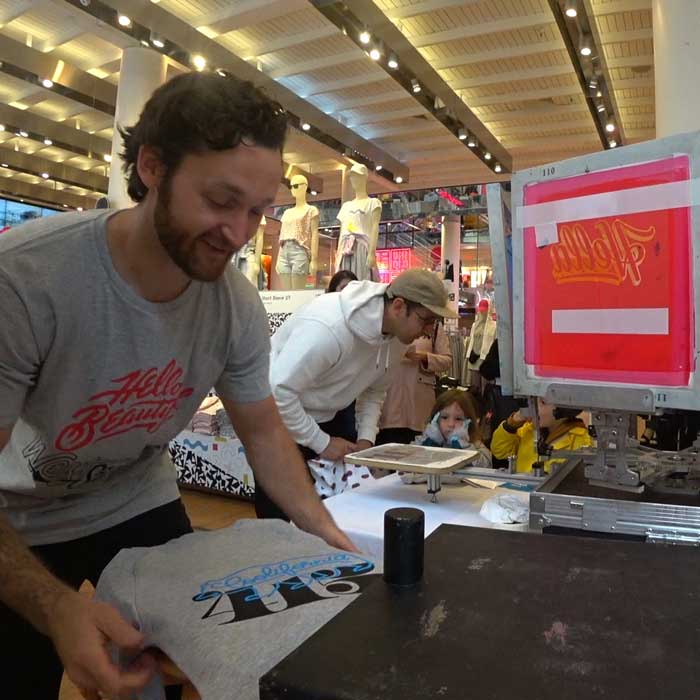
With two sets of hands in the shop, we wanted to speed up our workflow. Naturally, we stepped up to the press together to see if we could print simultaneously. What happened next changed my entire perspective on manual printing:
- Printer 1 (The Loader & Underbase Printer): Stood at Station 1, loaded the blank shirt, pulled down Color 1 (white underbase), stroked it, and rotated the platen under the flash cure.
- Printer 2 (The Finisher & Unloader): Stood at Station 3 right after the flash, immediately pulled down Color 2 and Color 3, printed the highlight colors, and pulled the finished shirt straight onto the conveyor belt dryer.
Because the Antec Legend was an All Heads Down press, both print heads could be locked into their registration gates simultaneously without warping the carousel, rubbing heads together, or throwing our tight multi-color alignment out of register.
We were producing a fully printed, multi-color, flashed garment every 10 to 12 seconds. That is 300+ shirts per hour on a manual press—numbers typically reserved for shops running entry-level automatics.
2. The Hard Lesson: The M&R Experience
As the shop grew, we needed a second press. I decided to buy a used machine from one of the biggest names in screen printing: M&R.
M&R makes legendary equipment, but most standard manual presses on the market are engineered as Single Head Down (All Heads Up) machines. They are designed with the mechanical assumption that only one screen will be in the down print position at any given moment.
We set up our new press, put two printers on it, loaded up a 3-color job with tight underbase trapping, and dropped two screens down at the same time.
The result was instant failure.
The carousel arms flexed under dual tension. The micro-registration gates binded, the off-contact shifted, and our prints were immediately blurry and out of registration. We quickly learned that on standard manual carousels, having two heads down simultaneously puts lateral and torsional stress on the center rotor that ruins registration integrity.
That was the exact moment the lightbulb went off: An All Heads Down press isn't just a minor bullet point on a spec sheet—it is an entirely different production machine.
3. Doubling Down: The Anatol Thunder
When it came time to expand our manual line again, we didn't make the same mistake twice. We specifically hunted for a press built from the ground up for true multi-operator, all-heads-down performance: the Anatol Thunder.
The Anatol Thunder (and machines like the Antec Legend or Vastex V-2000) feature heavy-duty dual-spring arms, reinforced central hubs, and independent registration bearings designed specifically to allow all print heads to remain locked down at the same time without losing a fraction of a millimeter in registration.
With two true All Heads Down presses running two-man teams, our shop was regularly pumping out 500 to 600 finished shirts an hour across two manual stations.
We were hitting production numbers that could compete full automatic shops with:
- Zero air compressors draining thousands of dollars in electric bills.
- Zero pneumatic valves leaking or failing mid-run.
- Zero $50,000 equipment debt hanging over our heads during slow winter months.
4. The "Micro-Timing" Hack for Standard Manual Presses
What if you already own an M&R, Riley Hopkins, or Workhorse manual press that is not true All Heads Down? Can you still get high-speed two-person output?
Yes—by mastering the "Gate Discipline" rhythm.
Even if your press cannot handle two screens locked into the registration gates at the exact same millisecond, you can establish an indexing rhythm that gets you 85% of the way there:
- Printer 1 strokes the underbase.
- The instant the stroke finishes, Printer 1 lifts the screen clearing the registration gate.
- The moment the gate is clear, Printer 2 drops their screen down into their gate and pulls the squeegee.
- As Printer 2 prints, Printer 1 indexes the carousel and loads the next garment.
It requires about 15 minutes of rhythm coordination between two printers, but once you dial in the cadence, you eliminate 90% of dead time.
5. The Business & Labor Math: Why This Strategy Wins
When you're building a screen printing business, your #1 enemy is fixed overhead debt.
When you buy a brand new automatic press on a 60-month equipment lease, that $800 to $1,500/month payment is due whether you print 10,000 shirts or 0 shirts that month.
With the All Heads Down manual strategy, you turn expensive fixed capital expenditure into flexible, low-cost operational labor:
| Strategy / Setup | Equipment Cost | Air Compressor & 3-Phase | Monthly Equipment Debt | Production Speed | Operators Needed |
|---|---|---|---|---|---|
| Entry Automatic Press | $35,000 – $60,000+ | $6,500+ (Compressor, Chiller, Drop) | $800 – $1,500 / mo | 300 – 450 pcs/hr | 2 Operators (Load & Catch) |
| All Heads Down 2-Man Team | $3,000 – $6,000 (Pro Manual) | $0 (Standard 110V/220V) | $0 / mo | 250 – 350 pcs/hr | 2 Operators (Load & Catch) |
Notice the most important line in that table: An automatic press still requires two people to run at full speed (one person loading collars straight, one person pulling shirts off and checking prints).
With an All Heads Down manual press, you are already paying for two people, but you avoided $50,000+ in debt, expensive shop remodeling, and catastrophic breakdown repair costs.
Training Low-Cost Labor in 15 Minutes
The beauty of this workflow is simplicity. You (the experienced printer) can take the lead station—managing shirt alignment, loading speed, and underbase opacity.
Your second operator doesn't need 5 years of screen printing experience. You can hire entry-level shop help and train them in under 15 minutes:
- Screen goes down.
- Pull squeegee at a 45-degree angle.
- Screen goes up.
- Pull shirt and lay on conveyor belt.
You get automatic-level output immediately while keeping your overhead razor-thin.
6. What Presses to Look For
If you are currently in the market for a manual press—whether new or scouring Facebook Marketplace and Craigslist—keep an eye out for these proven All Heads Down champions:
- Antec Legend / Dynamic: Renowned for their ultra-heavy cast aluminum construction and bi-directional indexing. One of the undisputed kings of all heads down printing.
- Anatol Thunder: Exceptional build quality with true all-heads-down registration and quick-release toolless micro-registration.
- Vastex V-2000 HD: Industrial-grade modular press built with heavy-gauge steel and lifetime-warranted steel registration bearings capable of multi-head engagement.
Final Thoughts: Don't Rush the Auto
Automatic presses are amazing machines, and when your shop is consistently printing 1,500+ shirts every single day with full-time pre-press support, making the jump to an automatic is the right move.
But don't let anyone tell you that you can't be fast, profitable, and highly productive on a manual press.
If you invest in a true All Heads Down manual press (or train your crew on high-speed gate discipline), you can push 300+ shirts an hour, fulfill major orders with ease, keep thousands of dollars of profit in your pocket, and scale your business on your own terms.